

School nutrition directors face a unique set of pressures every day: tighter budgets, fewer staff, evolving USDA guidelines, and the constant challenge of getting students to actually eat the healthy food on offer. The equipment in a cafeteria is not a background detail. It plays a direct role in whether students make nutritious choices, how quickly service lines move, and how efficiently a nutrition program runs.
Refrigerated merchandising solutions have become one of the most practical tools available to school districts looking to improve participation, reduce operational strain, and meet modern food service standards. Here is how they work, why they matter, and what to look for when evaluating options for your program.
Why Display Equipment Matters in a School Cafeteria
Students make food decisions in seconds. When healthy items are visible, well-lit, and easy to reach, students choose them at higher rates. When those same items are buried behind a service counter or tucked into a traditional refrigerator, they get skipped.
Open-air refrigerated merchandisers put food front and center. Milk, yogurt, fresh fruit, salads, sandwiches, and grab-and-go meals are immediately visible, accessible without staff assistance, and easy to reach quickly. For a cafeteria running a 25-minute lunch period, that speed of access matters as much as the food itself.
This shift toward self-service, grab-and-go formats is not a trend unique to K-12. It mirrors how convenience stores and grocery retailers have successfully increased sales of fresh items for years. Schools are applying the same merchandising logic to nutrition programs, with measurable results in participation rates.
The Operational Case for Self-Contained Units
One of the most practical advantages of modern refrigerated merchandising solutions for schools is the self-contained design. Unlike remote refrigeration systems that require dedicated compressor rooms, dedicated electrical infrastructure, and professional installation, self-contained units plug into a standard 120V outlet. No electrician. No construction. Facilities teams can deploy units across an entire district without specialized contractors.
That flexibility matters when districts need to place units in hallways, kiosk areas, or satellite locations outside the main cafeteria. Slim-profile models are specifically designed for these tighter spaces, expanding the reach of a nutrition program beyond the traditional serving line.
For nutrition directors coordinating across multiple school buildings, self-contained units offer:
- Consistent, reliable cold-holding performance across 50 or more district locations
- Easy relocation if serving line layouts change between school years
- Reduced dependency on facilities staff for installation and setup
- Simplified cleaning and maintenance with fewer components to service
- Energy Efficiency as a Budget Priority
Operating costs are a real concern for school districts managing tight per-meal budgets. Refrigeration equipment that runs continuously throughout the school day needs to be energy efficient, not just at the time of purchase, but over its full service life.
For districts under sustainability pressure from school boards or community stakeholders, the ability to point to genuine environmental performance, not just marketing claims, carries real value.
Choosing the Right Units for Your Cafeteria Layout
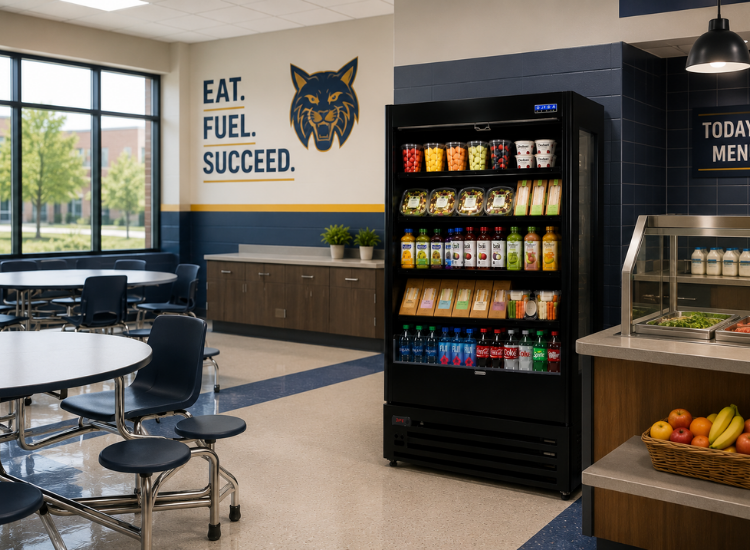
No two cafeterias are configured the same way, which is why a flexible product lineup matters for school districts. With Ojeda USA, you have the option to customize your unit with your school’s graphics or colors. Evaluating options should start with the specific role each unit will serve.
Main serving lines
Full-size open-air merchandisers are well-suited to main cafeteria serving lines, where high-volume display of milk, salads, sandwiches, and grab-and-go meals is the priority. Multiple size options allow districts to match unit footprint to available line space.
Hallways, kiosks, and satellite stations
Slim-profile units bring grab-and-go options to spaces that a standard merchandiser cannot fit. These are particularly effective for after-school programs, high-traffic hallways near gyms or libraries, and school stores where students stop between periods.
Renovated or showcase dining environments
Designer series units offer a premium aesthetic for schools investing in modern, student-centered dining environments. These are well-suited to renovated cafeterias where the design of the space is as intentional as the food program itself.
Point-of-sale and a la carte
Countertop and compact reach-in units work well for checkout-adjacent placement, where drinks, yogurt, and snacks are positioned for impulse purchase during the a la carte checkout moment.
Warranty Coverage and Long-Term Value
School environments are hard on equipment. Heavy student traffic, daily cleaning, and continuous operation across a 180-day school year put real demands on refrigeration units. Warranty terms are not a minor detail in a capital purchase decision for a district equipping ten, twenty, or fifty schools.
Ojeda USA backs its units with a 3-year warranty on parts and labor and a 5-year warranty on compressors. That coverage is three times the parts and labor protection offered by many premium-priced competitors, at a price point that allows districts to stretch their equipment budgets further.
Products are also stocked in the United States for fast delivery, which matters for districts working toward a summer installation window before the school year begins. Orders placed during the spring buying season, typically April through June, can be fulfilled in time for fall deployment without the 8- to 12-week lead times common with other manufacturers.
The Right Equipment Makes the Program Work Better
Refrigerated merchandising in a school cafeteria is not just a cold-storage function. It is part of how a nutrition program communicates with students, moves them through the line, meets food safety requirements, and delivers on the district’s goals for student health. The right equipment removes friction from every one of those outcomes.
Ojeda USA has spent over 78 years manufacturing refrigerated merchandising solutions built for exactly these kinds of demanding, high-use environments. The K-12 lineup is designed around the specific priorities nutrition directors care about most: value, efficiency, durability, and the flexibility to fit any school layout.
Ojeda USA has already been established in the United States, bringing proven experience and a long-standing commitment to the market. Explore the full K-12 product lineup and download spec sheets at ojedausa.com/k-12-solutions, or find your local Ojeda USA sales rep to discuss your district’s needs.